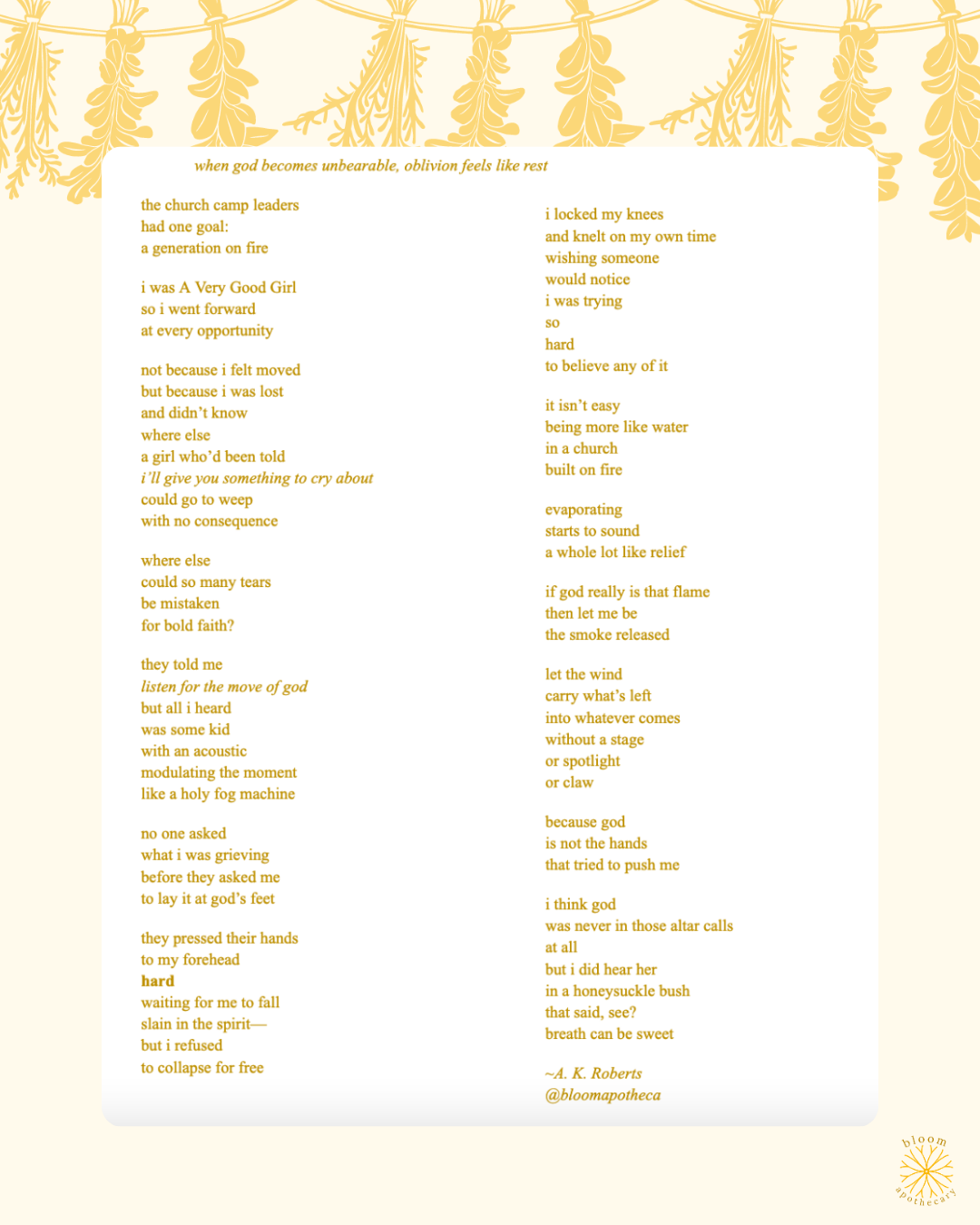
Hi, my name is Abby and I’m a heretic,
Jan 28, 2026
because I'm an Earth-worshipping animist who's loyal to Christ.
But, y’know… stick with me because it makes so much sense why 5-year-old me would cry and pray many nights, terrified, asking God why He would send people to hell, and if He would ever send me there too, only to hear the honeysuckle bush next to my house tell me there was nothing to fear when I smelled and tasted his flowers the next day.
It makes sense why preteen me physically recoiled when a Calvinist told me they wholeheartedly believed some human beings are damned from the beginning—created as fodder for eternal hell, ordained by their all-powerful God because ‘well, it’s a mystery we just don’t understand.’
It makes sense, too, why I never forgot the youth leader who told me my aunt, who succumbed to her own depression, deserved hell for “committing a murder for which she couldn’t repent.”
It makes sense why I ran toward Universalist Christianity and still felt lost, even after reading Love Wins and Razing Hell.
It makes sense why I tried so hard to reconcile the way plants, the creek, and Mother Earth herself talked with me with the way adults were always warning about demonic spirits always lurking, looking for ways to sneak inside my heart—despite also insisting the great battle of good and evil had already been won by our Christus Victor. If it ain’t Jesus, it’s demonic, y'hear.
It makes sense why my faith felt so utterly soul-crushingly confusing but never quite empty.
It makes sense why my teenage years became a quiet, lone philosophical quest—lying on my floor while my parents’ divorce raged on and my brothers chilled in the garage. Everyone argued or was emotionally just so weird, and so I started to disappear into my room. I was always googling whether Christians could receive Reiki or not, wondering where the miracles Jesus talked about actually were, trying yoga poses and energy healing on myself, playing music, writing poetry and slowly finding relief—only to feel crushed periodically by that nagging fear that it was actually all off-limits for me and I was indeed going to hell. I’d cry, pray, and ask God to forgive me if I was wrong. I flip flopped like this into my early twenties, until I found more Earth-based paths and rediscovered parts of my ancestral wisdom.
Looking back, it’s so beautiful to see that our Nazarene brother was with me the whole way. He’s always been a teacher and helper to me, ever since I can remember. I’ve felt weird talking about all this because it’s really a peculiar place I find myself in, standing in the doorway between religious people and non-religious people who will likely both misunderstand me. It feels kind of lonely sometimes, but less so as more and more people have the courage to be vulnerable and honest with their questions. But when everything else fell apart—when my life, my values, even my sense of existence didn’t make sense—at my very lowest moment I thought, I’ll write myself out a personal creed to get and keep me grounded, let’s see... That creed only had one item, and it was: ‘1. Jesus can be trusted.’
That was all I had. (This is a good story, but it’s a story for another day.) When I knew nothing else, I knew that if I followed his words and actions (unfiltered by my crippling existential fear or the interpretations of others), I would be okay. More than okay. I realized that I knew there was one safe, central point to decide everything else from—even if it looked different than how I was raised. Since that night, I've strived more and more to pursue only that which feels true to me in my core.
So, anyways, it also makes a whole helluva (ha) lot of sense why uprooting a worldview built on eternal conscious torment and an all-powerful God who allows it, brought such deep peace to my nervous system. This peace was earned, man. With literal blood, sweat, and tears. My life used to be constant existential crisis and panic. I can’t even begin to describe the panic attacks I used to have. Just ask my aunt and uncle who coached me through many of them. Countless. And that just... isn’t my life anymore. It’s been years since I’ve had one. My healing feels biblical— like the leper made clean, or the dead man raised, even.
That unraveling of my pysche and nervous system was long and costly, and it’s been fraught with real grief and so much fear to feel and process out. And self-doubt, and more fear, and worry about how I’ll come across. I am a preacher’s kid, after all. But in the last, mmm, five years or so I’d say, I’ve really come into myself spiritually—only now with the language and framework to hold what I intuitively knew to be true for me as a little kid.
I am fortunate to know the spirit of Yeshua, my teacher, for who he really is to me. And to relate with my God via the plants and animals and creeks and stones. That’s not to say it was an easy process getting here. It’s almost like my soul came into my body too quick, and I grew up lacking the cognitive scaffolding to hold a coherent ideology based on what I experienced in Nature versus what I was being told throughout my childhood.
I couldn’t fit the pieces all together without more life experience. I couldn’t formulate the proper thoughts and questions to communicate why I was feeling so awfully dissonant, so I just didn’t share with anyone at all. I flew under the radar, in pain. I was always so sensitive, perceptive, and alive to the world, but (well-meaningly) raised inside a theology that, at times, really fractured me. I tried to live like a good church-goer even though I felt like God made a whole lot more sense at the creek.
A major missing puzzle piece to many of my 3 a.m. existential crises was the work of a man named Thomas Jay Oord. He helped free my animistic inner world out from my inherited mental (and societal and, and, and…) framework. A lot of the questions I had that were barriers to exiting formal Christianity and still feeling safe are things that he addresses, and I recommend reading him for any downcast, confused, or dismayed Christians seeking a more true-to-them spirituality. Essentially, he says God’s love is real, active, and transformative, but God cannot unilaterally control anything, because love is non-coercive by nature.
God invites, persuades, and works relationally with ALL of creation, who all have agency—”from quarks to quasars,” he says. This means the rivers don’t rise by God’s unilateral control. This also means our choices matter a lot, human responsibility is real, and the suffering, injustice, and destruction in the world are not “allowed” by a tyrant God. Rather, they emerge from the free, relational field of creation. The eschaton is not decided yet.
What freedom in a theology and cosmology that allows for my way of being in the world. What responsibility there is in an existence that allows for my way of being in the world! I’m so proud of and grateful to all the versions of me leading up to this one here today, and I’m so thankful for all the goodness of others shared with me along the way.
So where did I land after deconstruction, you ask? Pending. But I can tell you this, at least. What I’ve found across philosophy, spirituality, and religions all around the world is really just this: at the end of the day, life makes the most sense when the Earth is treated as alive and relational (the Divine Mother herself if you ask me)—and when our meaning at a cosmic level all the way down is made without fear, control, conquest, punishment, or domination at its core. When humans see ourselves as an interconnected relational part of the whole of creation. God IS Love.
“The reason the moral arc of the universe is long but bends toward justice (and love) is that an amipotent Spirit invites but does not control creatures to act in ways that promote overall well-being.” — Thomas Jay Oord.
Basically, TL;DR: everything Indigenous people have told us for all of time.